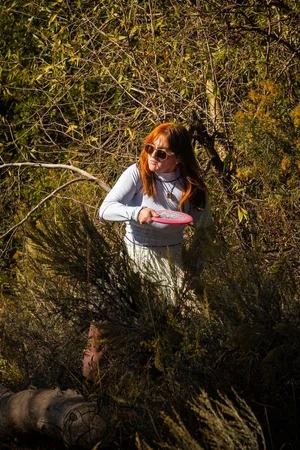
What Is Disc Golf? A Beginner's Guide to Getting Started
New to disc golf? Here's everything you need to know to get out on the course and start throwing.
If you've ever walked through a park and noticed metal baskets with chains, or seen someone throw what looks like a Frisbee into the woods, you've probably encountered disc golf.
Maybe you've wondered what they're doing. Maybe someone has invited you to play, but you weren't sure what to expect. Or maybe you're just looking for a new hobby that gets you outside, challenges you, and introduces you to some pretty great people.
Whatever brought you here, welcome!
Disc golf is a sport that's easy to try, challenging to master, and full of opportunities to grow. And the best part? You don't need any experience to get started.
So, What Exactly Is Disc Golf?
Disc golf is a sport that combines the basic concept of traditional golf with flying discs.
Instead of hitting a golf ball into a hole, players throw specially designed discs toward a metal basket. The goal is to complete each hole in as few throws as possible.
Just like traditional golf, disc golf courses have teeing areas, fairways, obstacles, and designated targets. Some courses wind through wooded areas, while others stretch across open fields or parks.
A typical course has 9 or 18 holes, although layouts can vary.
Each hole starts at a designated teeing area. Players throw their discs toward the basket, then continue throwing from where their discs land until they complete the hole.
That's the basic idea!
Of course, there's a lot more to discover as you play, but you don't need to understand every rule or throwing technique before your first round.
How Do You Play Disc Golf?
Let's walk through what a typical hole looks like.
Step 1: Find the Tee
Every hole begins at a designated teeing area, often marked by a concrete pad, sign, or other designated space.
Many courses have signs showing the hole number, distance, basket location, and possible obstacles.
Take a moment to look at the layout and figure out where you're throwing.
Step 2: Throw Your Disc
Your first throw on each hole is called your tee shot.
The goal is to move your disc toward the basket. You might throw directly toward it, aim around trees, or choose a shorter, more controlled throw.
Don't worry about distance just yet. Focus on throwing safely and getting comfortable with the motion.
Step 3: Play From Where Your Disc Lands
After your first throw, you'll make your next throw from where your disc came to rest, following the rules for establishing your lie.
Keep working your way toward the basket.
And yes, sometimes your disc will end up in a tree, behind a bush, or somewhere you definitely didn't intend.
That's part of the game.
Step 4: Finish the Hole
A hole is complete when your disc comes to rest supported by the basket's tray or chains, as permitted by the rules.
Count how many throws it took you to finish the hole. That's your score for that hole.
Then head to the next tee and do it all again!
Understanding Disc Golf Scoring
Disc golf uses a scoring system similar to traditional golf.
Every hole has a designated number of throws called par. Par represents the expected number of throws for completing that hole.
Here are a few terms you'll hear on the course:
Birdie: Finishing a hole one throw under par.
Par: Finishing a hole in the designated number of throws.
Bogey: Finishing a hole one throw over par.
Eagle: Finishing a hole two throws under par.
For example, if you're playing a par-3 hole and finish in two throws, you've made a birdie!
The player with the lowest total score at the end of the round wins.
But here's something worth remembering: you don't have to compete against anyone to enjoy disc golf.
Especially when you're starting out, your score is simply one way to track your progress. You can also celebrate making a good throw, navigating a difficult fairway, or finishing your first full round.
Those victories count, too.
What Equipment Do You Need?
One of the best things about disc golf is how little equipment you need to begin.
You don't need expensive clubs, special shoes, or a bag full of discs.
In fact, you can play your first round with just one disc.
Disc golf discs generally fall into three main categories:
Putters
Putters are typically slower-flying discs designed for control and accuracy.
They're commonly used for short approaches and putting into the basket, but they're also excellent for learning basic throwing techniques.
A beginner-friendly putter can be a great first disc.
Midranges
Midrange discs offer a balance of distance and control.
They're versatile, making them useful for a variety of shots and a popular choice for players who are still developing their technique.
Drivers
Drivers are designed for greater distance and generally have sharper, more aerodynamic rims.
There are different types of drivers, including fairway drivers and distance drivers.
Although it might be tempting to grab the fastest driver you can find, faster doesn't automatically mean farther. Some drivers require more throwing speed and technique to achieve their intended flight.
Our recommendation?
Start with a putter or a beginner-friendly midrange. Learn how your disc flies, get comfortable throwing it, and build from there.
You'll have plenty of time to explore new discs as your game develops.
Where Can You Play Disc Golf?
Disc golf courses can be found in public parks, recreation areas, wooded spaces, and dedicated disc golf facilities.
Many public courses are free to play, although some locations charge admission or course fees.
To find a course near you, try a disc golf course directory such as UDisc or the Professional Disc Golf Association (PDGA) course directory.
When choosing your first course, look for one with shorter holes, beginner-friendly layouts, and clearly marked teeing areas.
You don't need to tackle the longest or most difficult course in your area right away.
And if you have a friend who plays, ask them to show you around!
What Should You Know Before Your First Round?
You don't need to memorize the entire rulebook, but knowing a few basics can make your first experience more comfortable.
Be aware of your surroundings.
Never throw when someone is within range of your disc. Make sure the fairway is clear, and pay attention to other players and park visitors.
Respect the course.
Pick up your trash, avoid damaging trees or other natural features, and follow posted course rules.
Be considerate of other players.
Disc golf courses are shared spaces. If your group is moving slowly and another group is waiting, it's often courteous to let them play through when it's safe.
Don't worry about being perfect.
You might throw into the first available tree. You might miss a putt from five feet away. You might send a disc in a completely unexpected direction.
Even experienced players do these things.
Nobody starts out knowing exactly what they're doing, and learning is part of what makes the sport rewarding.
Why Give Disc Golf a Try?
There are plenty of reasons to fall in love with disc golf, and everyone seems to find their own.
For some, it's an opportunity to spend more time outdoors and get moving. For others, it's the challenge of developing a new skill or the excitement of competition.
Disc golf can be a casual afternoon activity, a way to connect with friends, or a sport you dedicate years to improving.
It can also introduce you to an entire community of people who share your enthusiasm.
And while disc golf is an individual sport in many competitive formats, you don't have to experience it alone. Local clubs, leagues, casual rounds, and tournaments offer opportunities to meet other players and find your people.
Finding Your Place in Disc Golf
Trying something new can feel intimidating, especially when it seems like everyone around you already knows what they're doing.
For girls and women entering disc golf, that feeling can sometimes be amplified by walking into a sport where men make up a large portion of the visible player community.
But you don't need to throw as far as someone else, use the same equipment, or develop your skills at the same pace to belong.
Your experience, your goals, and your progress matter.
Whether you want to enjoy occasional rounds with friends, join a women's league, or eventually compete at the highest levels of the sport, there's room for you in disc golf.
And that's exactly why Throw Like You exists.
We want more girls and women to discover the sport, find equipment and resources that support their development, and feel confident pursuing whatever disc golf means to them.
Ready to Give It a Try?
Here's your challenge: find a disc, find a course, and go throw.
You don't need a perfect plan or a complete understanding of the sport. Your first round is an opportunity to explore, experiment, and discover something new.
Maybe you'll fall in love with the challenge. Maybe you'll discover that you really enjoy putting. Maybe you'll spend half your round searching for a disc in the bushes.
Whatever happens, you'll have taken the first step.
And that first step matters.