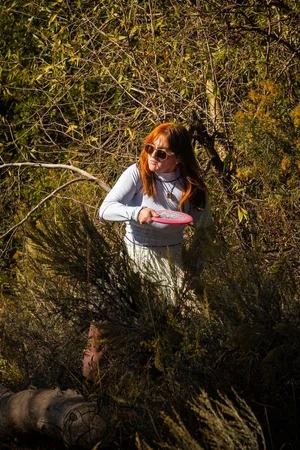
You don't have to know what you're doing to have a good time.
There's something intimidating about being the new girl in a sport, especially when you show up to a course and see people carrying bags full of discs, throwing farther than you thought was physically possible, and casually discussing things like hyzer angles and flight numbers. Meanwhile, you're standing there holding one disc, wondering if you're even gripping it correctly. It can feel like everyone else received an instruction manual that somehow missed your mailbox.
Here's what I want you to know: You belong on that course just as much as anyone else. You don't have to be good at disc golf to enjoy it, and you certainly don't have to understand every little detail before giving it a try. One of the things I love most about this sport is that there's always something new to learn. No matter how much I practice or how many rounds I play, there's another skill to develop, another challenge to tackle, or another opportunity to surprise myself. Some days everything seems to click, and other days I find myself wondering whether I've ever successfully thrown a disc in my life. Both are part of the experience, and somehow, both keep me coming back.
That's something I want more women to experience. Not because every gal needs to become a professional athlete or start competing in tournaments, although I'm certainly not going to discourage anyone from chasing a world championship, in fact I am rooting for you! I want more women to discover how rewarding it can be to find a sport that challenges them, gets them outside, and gives them something to be excited about. So, if you've been curious about disc golf but haven't quite worked up the courage to try it, consider this your invitation.
You Don't Need to Know Everything Before You Start
I think one of the biggest barriers to trying something new is feeling like you need to understand it before you're allowed to participate. Disc golf certainly doesn't make that easy with its endless terminology, different types of discs, flight numbers, throwing techniques, and rules. Someone starts explaining the difference between a hyzer and an anhyzer, and suddenly you're wondering whether you accidentally enrolled in a physics course. There's a lot to learn, but the good news is that you don't need to learn it all at once.
For your first round, the concept is pretty simple. You start at a designated tee area, throw your disc toward the basket, and continue throwing from wherever your disc lands until you get it into the basket. Then you move on to the next hole and do it again. The goal is to complete each hole in as few throws as possible, but there's absolutely no reason your first round needs to be focused on scoring. You can learn the official rules, terminology, and strategies as you become more comfortable. Right now, the most important thing is getting out there and giving yourself a chance to enjoy it.
And yes, you're probably going to throw some terrible shots. Your disc might fly directly into a tree (mine often do), take an unexpected turn into the bushes, or travel approximately twelve feet before deciding it's had enough. I've learned that discs don't always care about our intentions, and sometimes the best thing you can do is laugh, pick it up, and try again. Nobody starts out knowing exactly what they're doing, and making mistakes doesn't mean you're bad at disc golf. It means you're learning.
Let's Talk About the Discs
I love discs. Probably more than any reasonable person needs to, but that's a conversation for another day. What I don't love is how overwhelming choosing them can be when you're first getting started. There are so many brands, plastics, weights, flight numbers, and recommendations that it's easy to convince yourself you need to do three weeks of research before buying anything. You don't. In fact, you can play your entire first round with a single disc, and I actually think that's a great way to start.
A putter or midrange is usually a good choice for beginners because these discs tend to be easier to control at lower throwing speeds. You don't need the fastest driver on the market, and you definitely don't need an entire bag of discs just because someone else has one. There's plenty of time to explore different discs as you learn what works for you. Part of the fun is experimenting and discovering which discs feel comfortable in your hand and fly the way you want them to.
Something I think deserves more attention, especially when we're talking about getting more women into disc golf, is disc weight. Not everyone has the same throwing speed, strength, or technique, and equipment should reflect that. Lighter discs can be a fantastic option for players who are still developing their throws or who struggle to get heavier discs flying the way they're designed to. That doesn't mean every woman needs lightweight discs, and I don't particularly love the idea that women should automatically be handed the same equipment based on their gender. We deserve options, information, and the opportunity to figure out what works for our individual games.
There's a special kind of satisfaction that comes from finding a disc that just works for you. Suddenly, a throw you've been struggling with starts making sense, and you realize that sometimes the problem wasn't entirely your technique. Sometimes you just needed equipment that suited you better. We'll get into disc selection and flight numbers in another article, but for now, my advice is to start with something comfortable, keep an open mind, and don't feel pressured to buy everything at once.
Finding the Right Course Makes a Difference
One thing I feel pretty strongly about is choosing a good course for your first round. Disc golf courses vary quite a bit, and while I love a good challenge, I don't think your introduction to the sport needs to involve hiking through dense woods, navigating water hazards, or spending half your afternoon searching for a disc that disappeared into another dimension. There's a time and place for challenging courses, but when you're just getting started, it's nice to have somewhere you can focus on learning without feeling completely overwhelmed.
I recommend using UDisc to find a course that is rated “Easy” with shorter holes, relatively open fairways, and a layout that's easy to navigate. Nine-hole courses are especially nice because you can get a feel for the sport without committing to a full eighteen holes. They're also great for practicing as you improve, so don't think of them as courses you'll eventually outgrow. Sometimes a shorter, more technical course can teach you just as much as a long one.
One of My Favorites: McCowin Park
If you're in the Idaho Falls area, I have to recommend one of my personal favorites: McCowin Park in Ammon, Idaho. It's a nine-hole course that I think is fantastic for beginners, and it's somewhere I genuinely enjoy playing. The holes are relatively short, the terrain is fairly flat, and there are enough obstacles to keep things interesting without making the entire experience frustrating. It's also free to play, which makes trying disc golf even more accessible.
What I appreciate about McCowin is that you don't need to throw hundreds of feet to feel like you're actually playing the game. You can focus on getting comfortable with your discs, practicing your accuracy, and learning how to approach the basket without feeling like every hole is an impossible distance away. It's the kind of course where beginners can build confidence and more experienced players can still work on their skills. That's one of the reasons it's earned a spot among my favorites.
If you're local and looking for somewhere to try your first round, McCowin would absolutely be on my list. You can find course information and directions through UDisc. And if you're nowhere near eastern Idaho, UDisc is a great resource for finding courses in your own area. I'd recommend checking out the course descriptions and reviews to find somewhere that sounds beginner-friendly.
What Should You Actually Bring?
I promise you don't need an elaborate packing list to go throw plastic circles around a park. One or two discs, comfortable clothes, supportive shoes, and some water will cover most of what you need. Sunscreen is always a good idea, and I personally think snacks improve just about any outdoor activity. If you're playing somewhere unfamiliar, having a course map on your phone can also save you from wandering around trying to figure out where the next tee is.
As far as clothing goes, wear whatever makes you comfortable. Leggings, athletic shorts, joggers, oversized T-shirts, whatever you feel good moving around in. You don't need to look like a professional disc golfer to play disc golf, although I fully support using a new hobby as an excuse to find cute athletic clothes. I would pay attention to your shoes, though, because even relatively easy courses can have uneven terrain, wet grass, and spots where good traction makes a difference.
If you have a friend who already plays, ask them to take you out for a round. Having someone show you the basics can make the experience a little less intimidating. But if you don't know anyone who plays, please don't let that stop you. You can absolutely learn on your own, and there are plenty of resources available to help you along the way. You could also invite another gal who's never played before and figure things out together. There's something pretty fun about learning a new sport with someone who's just as clueless as you are.
A Few Things I Wish Every Beginner Knew
First, you don't have to keep score. I know that might sound strange when we're talking about a sport, but your first round doesn't need to be a competition. If you want to track your throws, that's great. If you'd rather spend the afternoon experimenting and figuring things out, that's great too. You can always start keeping score when you're ready, and there's nothing wrong with treating your first few rounds as practice.
Second, please don't get caught up comparing your distance to someone else's. This is something I think a lot of us struggle with, especially when we're surrounded by players who have been doing this for years. It's easy to watch someone launch a disc down the fairway and immediately feel disappointed in your own throw. But distance is only one part of disc golf. Accuracy, consistency, putting, and learning how your discs fly are all important skills, and they take time to develop. A controlled throw that lands where you intended can be far more useful than a powerful throw that ends up somewhere unfortunate.
Third, don't be embarrassed about making mistakes. I cannot emphasize this enough because I know how frustrating it can be when something doesn't go the way you wanted. Disc golf has a wonderful way of humbling you, sometimes immediately after you've started feeling particularly confident. You might throw an incredible drive and then miss a putt from a distance that seems almost impossible to miss. It happens. Even professional players make mistakes, and learning how to move on from a bad throw is part of becoming a better player.
There are also a few basic etiquette things worth knowing before you head out. Always make sure the area ahead of you is clear before throwing, be respectful of other players, and let faster groups play through when it's safe. If your disc is flying toward someone, yell "Fore!" to warn them. Pick up your trash, respect the park, and remember that other people are there to enjoy themselves too. You don't need to memorize the entire rulebook to be considerate on the course.
Finally, give yourself permission to enjoy the learning process. You don't have to turn every round into a serious training session, and you don't have to measure your progress against anyone else's. Some days you might want to practice a specific skill, and other days you might just want to get outside, spend time with friends, and throw some discs. Both are perfectly good reasons to play.
Girls, We Deserve to Take Up Space in Sports
This is probably the part I care about most, and a huge reason Throw Like You exists in the first place. I want more women playing disc golf. I want to see more girls picking up their first discs, more women joining leagues and tournaments, more friendships forming on the course, and more women discovering that they genuinely love being athletes. I want us to have access to equipment that meets our needs, opportunities to develop our skills, and communities where we feel welcome regardless of how much experience we have.
I also don't want women to feel like they have to approach the sport a certain way. Maybe you want a fun hobby that gets you outside on the weekends. Maybe you're looking for something you can enjoy with your friends or family. Maybe you're incredibly competitive and want to see just how good you can become. Personally, I love having something I can continually work toward. There's always another goal to chase, and I find that exciting. But that's my relationship with the sport, and yours doesn't have to look the same.
What matters is that we have the opportunity to participate, learn, and grow without feeling like we need to prove we deserve to be there. Disc golf has so much to offer, and I genuinely believe more women would fall in love with it if they felt comfortable giving it a chance. That's what I want Throw Like You to help accomplish. I want this to be a place where women can find information, encouragement, and eventually products and resources designed with them in mind. A place that celebrates the gal picking up her first disc just as much as the woman competing at the highest level.
Because there's room for all of us in this sport, and I'd really love to see more of us out there.
Now, Go Throw Some Discs!
If you've been waiting for a sign to try disc golf, I'd say this is a pretty good one. Find a course, grab a disc, invite a friend if you want, and go see what happens. You might discover your new favorite hobby, you might spend half the round laughing at your throws, or you might realize that you have a competitive streak you didn't know existed. Whatever happens, I hope you give yourself the chance to enjoy it without worrying too much about being good right away.
And if your first round is a complete disaster? Well, at least you'll have a story to tell. There's always another round, another throw, and another opportunity to improve. I'll be out there working on my game right alongside you, and I hope to see you on the course someday.
There's No Wrong Way to Start.
New to disc golf? Check out our What Is Disc Golf? A Beginner's Guide to Getting Started for an introduction to the sport, and keep exploring the Throw Like You Learn Hub for more tips, guides, and resources.